

Sudden urges to urinate. More bathroom trips than you used to need. Waking up at night just to go. Somewhere around 40, a lot of women start noticing this, and hormones and age have a lot to do with it.
Short answer: yes, it’s common after 40. But no, that doesn’t mean that you should just accept it and that you’re stuck with it. Overactive bladder (OAB) has underlying causes a doctor can actually find, and once that happens, treatment tends to work.
Professor Dr. Rajesh Kumar Tiwari, senior urologist at Big Apollo Spectra Hospital, treats cases such as these as it constantly affects women past 40. Talking to a urologist in Patna can be a prudent next step if these symptoms are getting in the way of your day. There’s no reason to sit on it.
Is Overactive Bladder Normal in Women Over 40?
“Needing to pee a lot” doesn’t even begin to cover this condition properly. OAB usually shows up as a cluster of symptoms: urgency, frequency, trips to the bathroom at night. So, we can say that it’s rare that just one of those symptoms presents on its own.
Here’s what surprises a lot of women when they first hear it: you don’t need to be leaking to have OAB. None at all, and it still counts. So, if you’ve been telling yourself it’s not “that bad” because nothing’s leaked yet, that’s not really the bar.
So, is overactive bladder dangerous after 40? Not in the sense of being an emergency, no. Annoying, yes. Disruptive, often. But symptoms that won’t go away on their own are worth a proper look, even if nothing about them screams urgent.
Plenty of women past 40 deal with some version of these symptoms. Age on its own isn’t a diagnosis though, and it shouldn’t be treated like one. If your bathroom habits have shifted lately, it’s worth reading up on frequent urination and its possible causes before you settle on OAB as the explanation. It could be something else entirely.
Why Does Overactive Bladder Become More Common in Women Over 40?
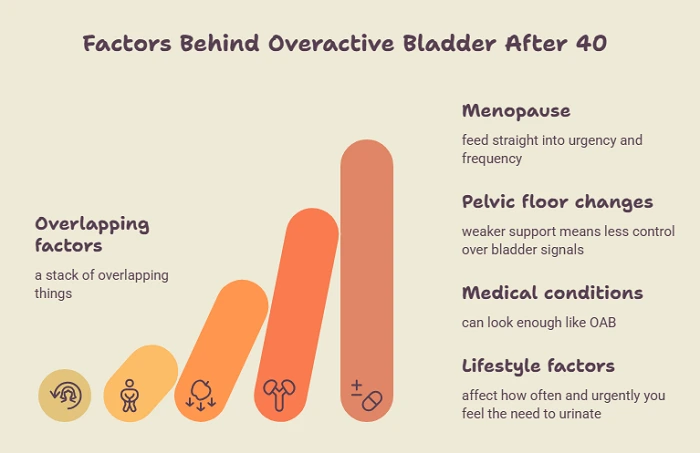
No single answer here. Honestly, most women have two or three of these going on at once, not just one.
1. Perimenopause and Menopause
Perimenopause and menopause come up first in almost every conversation about this, and for good reason. Oestrogen drops during this stretch, and that affects the urethra and vaginal tissue in ways that feed straight into urgency and frequency.
2. Pelvic Floor Changes
Pelvic floor support gets less over time with aging, but it matters just as much. Pregnancy. Childbirth. Years of regular ageing. All of it slowly wears down how well the pelvic floor holds things in place, and weaker support means less control over bladder signals.
3. Bladder Muscle Changes
Sometimes the bladder muscle itself just behaves differently as you get older. That’s real, but it’s rarely the whole explanation, and a good doctor won’t stop looking there.
4. Medical Conditions
Diabetes. Urinary tract infections. A few neurological conditions. Any of these can look enough like OAB that telling them apart takes an actual exam, not guesswork.
5. Medication and Lifestyle Factors
And then there’s everyday stuff. Caffeine. How much you’re drinking across the day. Certain medications. None of it gets talked about as much as hormones, but it adds up and can affect how often and urgently you feel the need to urinate.
Put it all together and that’s roughly what causes overactive bladder after 40 for most women, a stack of overlapping things rather than one clean trigger.
Menopause doesn’t cause OAB for every woman automatically either, which surprises people. These factors tend to pile on top of each other instead of acting alone.
NOTE: Stress incontinence, the leakage you get during coughing or sneezing. It can show up alongside OAB, but it’s its own condition, and the treatment isn’t identical.
Figuring out which of these fit your situation is useful before you even walk into the doctor’s office. Not every pattern needs the same level of alarm, though, so next up is sorting out what actually warrants concern versus what doesn’t.
When Is Overactive Bladder a Cause for Concern in Females?

Urgency that won’t quit. Sleep that’s falling apart because of bathroom trips. Leakage. Daily life getting harder to manage because you’re constantly thinking about where the nearest toilet is. Any of that is reason enough to book an appointment. You don’t need to wait for it to get “bad enough.”
A few conditions mimic OAB closely in the early stages, which is exactly why self-diagnosing tends to backfire. UTI, diabetes, bladder pain syndrome, they can all produce similar symptoms, and each one needs its own treatment path.
Some things shouldn’t wait at all.
- Blood in the urine.
- Pain while urinating.
- Anything new that’s getting worse fast rather than staying steady.
- Fever, chills, flank pain
- not being able to pass urine
These point toward something more serious than straightforward OAB.
If what you’re noticing also looks like it overlaps with bladder pain syndrome and UTI, get that sorted properly with the help of a urologist. They can look nearly identical on the surface and still need completely different treatment.
Also, knowing the warning signs is one thing. Knowing what a doctor actually does with that information is the next piece.

How Is Overactive Bladder Diagnosed in Women Over 40?
Diagnosis at this age usually starts with a simple question: is this age doing its thing, or is this actually OAB? The two can look frustratingly similar at first glance.
- Your doctor will ask where you stand hormonally, mainly about your menopausal status, because that shapes a lot of what gets investigated next. Perimenopausal? Postmenopausal? Still cycling like normal? Your answer points the workup in a slightly different direction.
- From there it’s usually a symptom history and a short bladder diary. Fluid intake, caffeine habits, whatever medications you’re currently on, since a surprising number of common prescriptions mess with bladder behaviour without you ever realising it.
- Diabetes and thyroid issues both become more common as you age, so your doctor may screen for these alongside a standard urine test. Sometimes a physical exam gets added. Occasionally, residual urine testing is added too as a part of the diagnostic workup.
Most patients will not need all of these tests; however, what matters most is based upon your individual symptoms and not a “one size fits all” checklist.
Finding out the true cause of your symptoms is very important, as many times kidney/urinary tract issues can be confused with what appears to be simply OAB.
Once your doctor has determined what is causing your symptoms, then treatment can begin to be discussed as opposed to being a guessing game.
What Treatments Can Help Women Over 40?

There is no single treatment plan that works for everyone. The treatment that you receive will depend on your specific triggers, where you are hormonally, and how much this is affecting your daily life.
1. Step One: Habits and Hormones Together
Habits and hormones are usually addressed first. This includes cutting back on caffeine. Drinking enough fluids (not too much) is also part of the plan.
If you are perimenopausal or menopausal, your doctor may also discuss if this is contributing to your symptoms, and if so, how it may change the treatment plan compared to someone who is younger.
2. Step Two: Retraining the Bladder
Bladder retraining is typically the next step. You will gradually increase the time between each visit to the bathroom, continue to do so for several weeks, and eventually the urgency signal will recalibrate.
Overactive bladder exercises for women over 40, especially pelvic floor exercises, are most effective when they are used in conjunction with bladder retraining as opposed to being done as a standalone fix.
3. Step Three: Medical Support If Needed
Medical support kicks in if the basics aren’t cutting it. There’s no single best medicine for overactive bladder in menopause that works across the board, and if anyone tells you otherwise, be skeptical.
A urologist/gynaecologist doctor looks at your symptoms and where you are hormonally before prescribing anything at all.
So, if you’re wondering what does overactive bladder treatment after menopause actually look like in practice, know that assessing daily habits always comes first. Bladder retraining often runs alongside.
Medication is prescribed only if those two together still aren’t enough. Our guide on overactive bladder in women goes deeper into management strategies if you want the fuller picture.
Consult a doctor and get a plan built around your actual situation and the stage of life, not generic advice.
Warning Signs That Warrant a Urology Consultation
You don’t have to wait for things to get severe. You don’t have to wait for leakage to start either.
- Urgency that won’t ease up,
- symptoms getting worse instead of better,
- anything disrupting your sleep or your day,
These warning signs are enough on their own to pick up the phone and book a consultation.
A specialist can actually work out whether this is OAB or something else entirely, instead of you sitting there guessing.
Structured care through urology services at BIG Apollo Spectra Hospital means your treatment plan gets built around your actual diagnosis, not some generic protocol applied to everyone who walks through the door.
A urologist doctor in Patna can look at what you’re experiencing and build treatment around what’s genuinely causing it, not your age, and not general assumptions about menopause that may or may not even apply to you.

FAQs
1. Is overactive bladder a normal part of ageing?
It is common after 40 but not something you should just accept. Most cases respond well to treatment once they’re actually diagnosed.
2. Can an overactive bladder go back to normal?
Plenty of women see real improvement with treatment. “Managed” is probably more honest than “cured” as a word, if we’re being precise. Lasting relief usually comes from stacking a few approaches together rather than finding one magic fix.
3. How to stop overactive bladder in females?
Bladder training, pelvic floor work, a few lifestyle tweaks, that’s the usual starting point. Medication gets added later if those alone aren’t enough.
4. Can menopause cause frequent urination?
It can contribute, yes, through hormonal effects on bladder tissue. But menopause by itself doesn’t guarantee OAB shows up. Plenty of women go through it without developing the condition at all.
5. How many times a day should a woman over 40 urinate?
No magic number applies to everyone. What actually matters is whether your own pattern has shifted from what’s normal for you specifically.
6. Can overactive bladder be managed without medication?
Often, yes. Bladder training, pelvic floor work, and some lifestyle changes handle a lot of cases before medication even enters the picture.
Bladder Symptoms Should Not Be Ignored
Getting more common after 40 doesn’t make bladder symptoms normal. Those are two different things, and it’s worth holding onto that distinction.
Many women also wonder “Is overactive bladder curable after menopause?” The answer is it is not guaranteed for every single woman, but most see real, lasting improvement once they’re on the right combination of treatment.
The best course of action is to track what you’re noticing. Don’t put off getting checked just because it hasn’t gotten unbearable yet.
If bathroom trips, urgency, or disturbed sleep are wearing you down, BIG Apollo Spectra Hospital’s urology team can help find the cause and get you started on the right treatment plan.