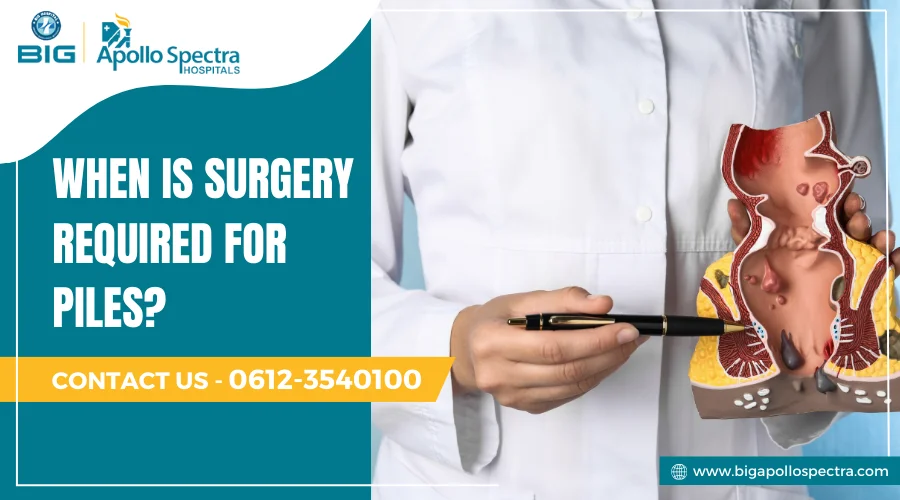
Piles or hemorrhoids are inflamed or swollen blood vessels in the rectum or the anal area. They usually cause pain, itching, bleeding, and discomfort. You should know that you are not the only one suffering from it.
Piles are a very common problem that primarily occurs due to prolonged sitting, straining during defecation, obesity, or pregnancy.
The good news? Most cases get better by making lifestyle changes, taking medications, and using home remedies. Although it is less common, there may be some cases that require surgery.
Knowing the reasons why surgery can be the last resort allows you to understand your health better and decide when to go for proper treatment. This guide explains the situations when it becomes necessary to carry out surgery and the options you have.
There may be cases when piles operation becomes unavoidable if they persist despite all your efforts of getting rid of them. When do non-surgical means fail and when is an operation required?
Let’s have a look at such circumstances when conservative approaches are no longer effective, and surgical intervention is the best possible solution.
When is Surgery Required for Piles?
Management of pile diseases largely depends on non-surgical means. Generally, your doctor will initiate treatment by using various types of cream or ointment to decrease swelling and pain, besides giving you fiber supplements and recommending dietary changes to ease bowel movements.
A warm sitz bath is always a source of relief and comfort, while small hemorrhoids can be efficiently treated with less invasive methods like rubber band ligation or sclerotherapy.
But what if these methods fail? If the hemorrhoids keep growing, causing bleeding and pain that is unbearable, and you do not see any positive effects from conservative treatment, then perhaps the answer to your problem is surgery.
If wondering what size hemorrhoids need surgery, in most cases, it is the large, prolapsed hemorrhoids that have caused severe complications which are the reasons for surgical consideration.
This is when a professional like a laparoscopic surgeon in Patna can be helpful. The specialist will assess your problem and recommend the right solution.
Big Apollo Spectra Hospital is equipped not only to diagnose your condition in detail but also to provide you with comprehensive piles treatment including surgery (when needed) thanks to its experienced team of doctors.
Knowing the signs that call for professional intervention is a big step towards making the right decision. Take a look at symptoms that indicate the necessity for surgical intervention.
6 Complications of Piles That Warrant Surgery
Common piles symptoms are bleeding, pain, itching, and prolapsed hemorrhoids. While most symptoms are manageable, certain complications may require surgery. Here is detailed necessary information about each.
1. Bleeding
Bright red blood seen during or after bowel movements is typical with piles. In general, conservative care is enough to handle the situation and occasional bleeding is not cause for alarm. Nevertheless, a persistent or heavy bleeding that continues even after treatment calls for a surgical evaluation.
2. Pain or Discomfort
Discomfort may be caused by sitting or during a bowel movement and thus affect your daily activities. Pain of mild or moderate intensity is responsive to home remedies and creams. If, however, the pain is severe, it is continuous and severely interrupts your daily routine, then it is an indication for the need of surgical intervention.
3. Itching or Irritation
Anus itching is an irritating feeling but most of the time it is under control. Usually, relief is achieved by topical treatments and hygiene. However, long-lasting itching that does not respond to the standard treatment may indicate the need for surgical intervention.
4. Prolapsed Hemorrhoids
Internal hemorrhoids that are prolapsed outside of the body cause the person to be very uncomfortable. At least initially, manual reduction may help.
However, hemorrhoids that repeatedly prolapse and won’t stay inside or produce serious symptoms should be addressed by a surgeon.
5. Thrombosis (Blood Clots)
Hemorrhoid blood clots resulting in sudden and severe pain is the case of thrombosis. This situation is a medical emergency that requires help from a professional. In general, thrombosis needs surgery to stop serious complications and to let the patient be relieved of the suffering.
6. Severe Inflammation
Excess swelling and inflammation are signs of quite advanced hemorrhoid disease. When inflammation becomes serious, the patient is hardly able to get relief from topical treatments and his/her quality of life is affected, and consequently, surgery arises as a logical solution for permanence of relief and comfort.
There are different surgical methods, each with its own recovery timeline and effectiveness levels. Your doctor will decide which is the best treatment for you depending on the severity of your hemorrhoids and your general health condition.
Surgical Options for Piles
Following are some of the options patients have when opting for surgical interventions to treat piles.
1. Hemorrhoidectomy
For those with very severe or large hemorrhoids, surgery (hemorrhoidectomy) is the most effective choice. Usually under general anesthesia, this operation removes hemorrhoidal tissue from your anal area.
Sure, the whole recovery process takes several weeks with some discomfort, but it’s one of the last resorts which works wonderfully. So, the majority of such patients consider the discomfort during recovery as a thing of the past since their symptoms are gone.
2. Stapled Hemorrhoidopexy
Going in for this kind of operation essentially means opting for a gentler approach. A stapling device is used in this procedure to remove the excess tissue and also to reposition hemorrhoids inside the rectum.
The main thing you have to know here is that the pain after stapled Hemorrhoidopexy is considerably lesser than after conventional surgery and the patient recovers faster, so this technique is very much preferred by those who want to achieve results quickly.
3. Laser Treatment
Laser Treatment is the method using targeted heat, resulting in blood vessel coagulation. In this way, the vessels shrink and the swelling disappears.
The intervention is so minimally invasive that the post-op recovery phase is short and the patient rapidly becomes fit again. However, a general surgery specialist in Patna will firmly recommend this treatment only if your hemorrhoids fit the criteria; otherwise, this is a no-go.
Each procedure has its own pros. Hemorrhoid removal without surgery is still an option for milder cases, while severely advanced ones will typically require a surgical intervention.
Choosing to have an operation means taking into account the good things and the downsides of it. Here’s what the scientific evidence says about both sides of this evaluation.
Risks and Benefits of Surgical Intervention
Surgery does provide real benefits. You receive both immediate and long-term relief of symptoms—no more pain, bleeding, or discomfort interrupting your daily routine.
Those large or prolapsed hemorrhoids that are resistant to other treatments can be surgically removed permanently. The operation also helps manage the risks of complications like thrombosis or recurring prolapse.
However, the operation comes with its own risks that you should be aware of. During initial recovery, pain is common. There could be an infection at the surgical site, but it is very unlikely when modern techniques are used. Sometimes incontinence occurs, but in the majority of cases, it is only temporary. So, is hemorrhoid surgery worth it??
For many of those who have severe symptoms, the answer would be yes—the relief from symptoms in the long run is worth the discomfort they go through for a short period of time.
Piles surgery cost varies depending on your procedure type and location, whereas the hemorrhoid surgery recovery time is usually two to four weeks for most patients. Life after hemorrhoid surgery is normal once the healing process is over—most likely, you will be feeling a lot better.
The decision of whether or not to undergo such an operation should be very carefully guided by your medical practitioner. Our doctors will evaluate the severity of your hemorrhoids, your general health status, and possible complications given your medical history.
Stop Suffering—Get Proper Piles Treatment
When all conservative treatments have failed and you have developed complications, surgery is the option that remains.
If you are afflicted with extreme pain, bleeding that lasts for a long time, or suffer from prolapsed hemorrhoids that won’t reduce manually, you should see a doctor and discuss the possibilities of surgical treatment. The operation provides great relief but it is accompanied by some risks, hence you should explore all other treatments first.
So, what’s the silver lining? It is quite rare that one eventually has to undergo surgery since early intervention and lifestyle modifications take care of everything most of the time.
You protect yourself from the problem by raising your fiber intake, drinking enough water, and not straining for a long period. The day this operation becomes unavoidable, it is a source of comfort to know that it is able to give you a lasting solution to your piles problem and thus allowing you to regain your previous level of happiness.
Suffering in silence is not a remedy – talk to a doctor who will evaluate your case and plan the course of your treatment accordingly.