There’s no single fixed approach for COPD treatment in Patna. What treatment plan you need often depends on your symptoms, your lung function, and your overall health, and a pulmonology specialist puts it together based on your specific case.
Chronic Obstructive Pulmonary Disease is a long-term lung condition that makes breathing harder as time passes.
Maybe you’ve had a cough that won’t quit for weeks now or you’re more breathless than usual doing things that never used to bother you, like climbing a flight of stairs, walking to the market. Wheezing and mucus that just won’t clear up are common too.
COPD can’t be reversed, but treatment does help, controlling symptoms, cutting down flare-ups, getting your routine back to somewhat normal.
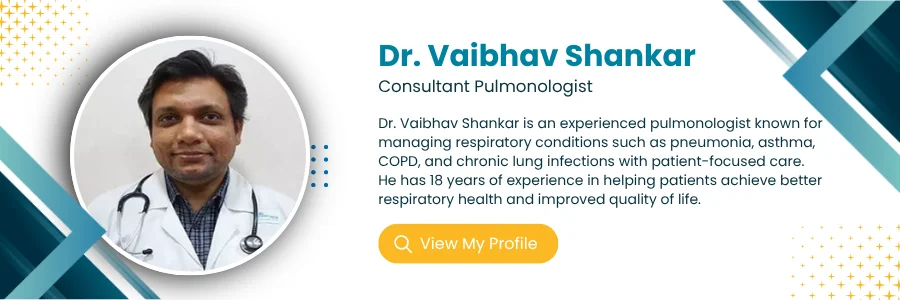
Dr. Vaibhav Shankar, Pulmonologist and Sleep Medicine Expert at Big Apollo Spectra Hospital, evaluates COPD patients through detailed history-taking and lung function testing. Hospital-based respiratory care is also available at the well-equipped pulmonology department of Big Apollo Spectra.
Your breathing a year from now doesn’t have to look like your breathing today. Consult a lung specialist in Patna >>
COPD Treatment in Patna
No two COPD treatment plans look quite the same. Your pulmonologist weighs several things together, not just whatever symptom happens to be bothering you that particular week.
How severe is your COPD? How often do flare-ups hit? What do your spirometry results show, and where do your oxygen levels sit? Smoking history matters, so do other health conditions you’re already managing, and any past hospital stays tied to your breathing.
Two people can carry the exact same diagnosis on paper and still walk out with fairly different treatment plans, because what’s underneath rarely matches up.
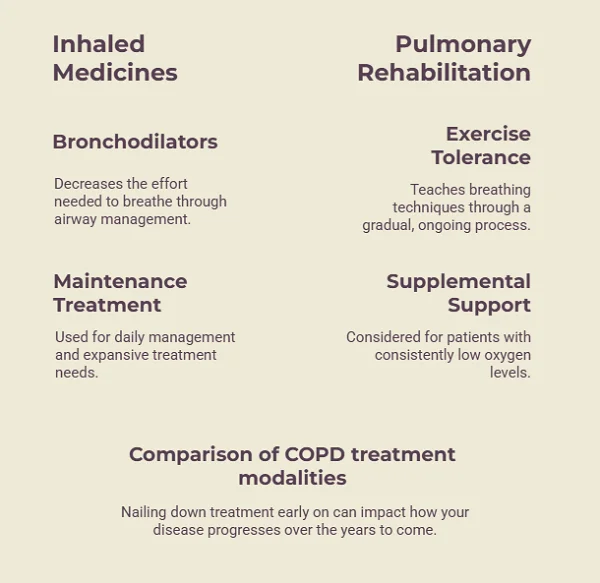
1. Inhaled Medicines
Bronchodilators do the majority of work in COPD management. Bronchodilators help open the airways by relaxing the muscles around them. This decreases the effort needed to breathe. Long-acting inhalers are typically used for maintenance treatment.
Combination inhalers use two types of medication. These are used when more expansive treatment is necessary. Inhaled corticosteroids may also be prescribed, but only for specific patients that will see benefit.
2. Pulmonary Rehabilitation
Pulmonary rehab is worth taking seriously, even though it’s easy to brush off. It builds exercise tolerance, teaches breathing techniques, and it’s a gradual process rather than something you do once and forget about.
Oxygen therapy is a bit different. If your oxygen levels run consistently low, it might be considered as supplemental support, but that decision is based on measured oxygen saturation, not on how breathless you happen to feel on a given day.
Flare-ups are a category all their own. Increased shortness of breath, excess sputum production or a change in its colour. Acute respiratory distress.
Any of the above warrant a trip to the doctor rather than “riding it out” at home, and serious flare-ups can even require monitoring in the hospital until they subside.
If your symptoms persist, or if you’ve already been diagnosed with COPD, you may want to discuss with your pulmonologist whether your current treatment plan is still right for you.
Nailing down treatment early on can impact how your disease progresses over the years to come. But first, your doctor has to get an accurate diagnosis.

How Is COPD Diagnosed Before Treatment?
COPD diagnosis happens well before a prescription gets written. Your doctor needs to know what’s actually going on in your lungs, not just what you’re describing to them in the waiting room.
- It usually starts with a fairly detailed conversation about your symptoms and medical history. Your doctor will ask about smoking or tobacco history, dust or fume exposure at work, how your breathlessness shows up day to day, whether your cough has become chronic, sputum production, past respiratory infections, and how often flare-ups have happened.
- A physical exam follows, where your doctor listens to your breathing and checks for the signs that point toward COPD.
- Spirometry is where the real diagnostic work happens. This COPD lung function test measures how much air you can exhale and how fast, and that’s what confirms airflow limitation, the hallmark of COPD. It’s simple, non-invasive, though it does need your active participation to give reliable results.
Other tests might follow depending on what your doctor finds: a chest X-ray to rule out unrelated lung problems, an oxygen saturation check, maybe blood work if it’s warranted. Our guide on spirometry vs chest X-ray goes into more detail on what each test can and can’t tell your doctor.
Diagnosis is never one test result on its own. It’s history, exam, and test findings viewed together. Once your doctor has that fuller picture, they’re also in a better position to flag what tends to set your symptoms off.
Common COPD Symptoms That Need Medical Attention

COPD creeps up on people. That’s a big part of why so many wait too long before getting checked.
- A cough that won’t go away
- Excess mucus
- Wheezing
- Shortness of breath, especially during activities that used to be easy
- Chest tightness
- Catching respiratory infections more often than before
- Struggling when climbing stairs or carrying groceries, tasks that shouldn’t feel this hard
Some people notice it in smaller ways too. Getting tired faster during light housework. A short walk leaves them more winded than it used to.
Once these symptoms stop being occasional and start showing up persistently, or getting worse, that’s your cue.
A cough that drags on for weeks, breathlessness showing up during things you used to manage without a second thought, don’t wait that out. Get checked by a lung specialist earlier and you’ll usually have more treatment options open to you.
What Can Trigger COPD Exacerbations?
COPD doesn’t always worsen gradually. It can spike suddenly, and knowing your own triggers means responding faster when it does.
Respiratory infections top the list, along with air pollution, smoke exposure, dust and occupational irritants.
Skipping doses of your prescribed treatment doesn’t help either, and neither does an unrelated illness stacking on top of existing COPD. Even an ordinary cold can knock a stable patient off balance pretty quickly.
Repeated flare-ups often mean your treatment needs adjusting. Sometimes hospital care becomes the only real option to bring things back under control.
If you’re dealing with a respiratory infection alongside your COPD, our piece on bronchitis treatment in Patna covers how overlapping symptoms like these are usually managed.
Catch your personal triggers early, and a mild flare-up is a lot less likely to turn into a hospital visit. There’s plenty you can do day-to-day, beyond medication, to keep COPD in check.
Lifestyle Changes Alongside COPD Treatment
Medication is only part of the equation here.
- Quitting smoking, completely, is the single biggest leverage you have. Continued smoking speeds up lung damage regardless of what medication you’re on, no exceptions.
- Steering clear of second-hand smoke and cutting down exposure to dust and air pollutants helps too, though it’s often the harder part to control depending on where you live and work.
- Staying active in ways your doctor considers safe for you, along with breathing exercises, keeps your lung function from deteriorating further.
- Keeping vaccinations current lowers infection risk.
- Sticking with your inhaler therapy consistently, along with showing up for follow-up appointments, rounds out the basics.
Our guide on lifestyle changes to manage COPD walks through these changes in more detail if you want the fuller picture on practical lifestyle changes that you can make.
None of it cures COPD, but it does slow things down and cut down on flare-ups. At some point, though, managing things on your own isn’t enough anymore, and that’s when specialist care comes in.
When Should You See a Pulmonologist for COPD?
Managing symptoms day to day is one thing. Knowing when to escalate is a different matter altogether, and a lot of patients get this wrong by waiting too long.
The following are some symptoms that should prompt a specialist consultation:
- Persistent breathlessness.
- A chronic cough or mucus that won’t clear.
- Chest infections that keep coming back.
- Abnormal spirometry results.
- COPD flare-ups are happening more often than they used to.
Leaning more and more on rescue medication, or an existing case of COPD that just isn’t responding the way it should, are all signals worth acting on.
Don’t try to self-diagnose based on symptoms alone, since breathlessness and cough show up in plenty of conditions besides COPD. A pulmonologist in Patna can actually tell the difference between COPD, asthma, and heart-related breathlessness through proper testing, rather than leaving you to guess which one it is.
Wait too long to see a specialist and you often end up starting treatment at a more advanced stage than you needed to, when a simpler fix might have worked earlier on.

Why Choose a Hospital for COPD Treatment in Patna?
Hospital-based respiratory care can coordinate many resources that can be difficult to access independently. You have direct access to pulmonologists who can accurately assess your COPD with the use of lung-function testing and imaging if necessary.
This is important because COPD is not a set in stone diagnosis. Your COPD needs to be reevaluated periodically. Every few months or so or less frequently if your condition has stabilized.
A hospital setting also means acute exacerbations get managed properly and complications get caught early if your condition takes an unexpected turn.
If you’re juggling other conditions alongside COPD, heart disease or diabetes, say, coordinated care becomes genuinely useful since these can shape your respiratory treatment too.
Then there’s the long game. COPD isn’t something you treat once and move on from. Sticking with the same COPD hospital in Patna and the same pulmonology team gives you a kind of continuity that’s hard to replicate if you’re bouncing between different clinics.
Our pulmonology team handles diagnostics, treatment planning, and follow-up care under one roof, which is worth knowing if you’re searching for COPD treatment near me in Patna.
What to Expect During a Consultation?

A COPD consultation follows a fairly predictable structure.
You’ll talk through your symptoms and history first, then a respiratory exam, then a look at whatever past reports you’ve brought along. A lung-function assessment happens where it makes sense, and your doctor builds a plan from there, one shaped around your case specifically rather than a generic protocol.
Beyond the prescription itself, you’ll get guidance on lifestyle changes, inhaler technique, and what your follow-up schedule should look like.
Consult the best pulmonologist doctor in Patna, Dr. Vaibhav Shankar, for a personalised COPD evaluation.
You leave with a plan built around your actual condition, not a checklist handed to every patient who walks through the door.
COPD Treatment: SOS Symptoms to Seek Hospital Care
Some COPD symptoms shouldn’t be waited out for a scheduled appointment.
- Rapidly worsening breathlessness is one symptom. Trouble speaking because you’re too breathless is another.
- Watch too for lips or skin turning bluish or grey, confusion, unusual drowsiness, oxygen levels that read dangerously low, or symptoms getting worse despite the treatment you’re already on.
None of these are symptoms to sit with at home and hope they will pass.
Severe breathing difficulty is a medical emergency, plain and simple. If you or someone with you shows these signs, head straight to our emergency hospital in Patna rather than waiting for the next outpatient slot to open up.
Knowing these red flags ahead of time saves you the minutes you’d otherwise lose trying to decide how serious things really are.
Frequently Asked Questions
1. Can COPD be completely cured?
No, it can’t. But the right treatment controls symptoms, slows progression, and can noticeably improve how you feel day to day.
2. What is the main treatment for COPD?
Inhaled bronchodilators, and corticosteroids in select cases, form the core, usually alongside pulmonary rehabilitation and lifestyle changes.
3. Is COPD treatment lifelong?
Yes. Since it’s a chronic condition, treatment and monitoring generally continue long-term, with adjustments made as symptoms shift.
4. Can COPD patients live a normal life?
Many manage their daily routines reasonably well with consistent treatment, though this depends heavily on disease severity and how closely the plan is followed.
5. Does COPD always require oxygen therapy?
No. It’s only considered when oxygen levels run significantly low, not for every diagnosed patient.
6. Which doctor treats COPD?
A pulmonologist, known as a lung and respiratory specialist, handles COPD from diagnosis through ongoing treatment.
7. Is spirometry necessary to confirm COPD?
Yes, it’s the key test for confirming airflow limitation, and it backs up your doctor’s clinical assessment.
8. When does COPD require hospitalisation?
Usually during severe flare-ups, when oxygen levels drop sharply, or when outpatient treatment simply isn’t holding symptoms in check anymore.
Seek Timely Care for COPD
COPD is not an acute problem you solve and then overcome from it. It’s chronic, and your management plan should follow your symptoms and pulmonary function as they change.
The sooner you get evaluated the better chance you have of finding an appropriate plan before it gets worse, and persistent respiratory symptoms warrant an evaluation, not assumptions.
If you’re weighing COPD treatment options, trying to understand your COPD treatment drugs, or checking whether COPD treatment injection options apply to your case, our team can walk you through it.
So, if you want a specialist in Patna who can answer questions on the treatment cost and what ongoing chronic obstructive pulmonary disease treatment actually looks like for you, visit us in Agamkuan. Schedule your consultation at Big Apollo Spectra Hospital.