
Occasionally forget where you parked your car or left your keys? Don’t worry, it’s just a normal thing that people do from time to time. Most people over 60 forget things now and then, and it’s just natural aging, nothing to fear.
Dementia, on the other hand, is a condition which leads to a consistent deterioration in the ability to remember, think, and carry out activities of daily living. It is a problem that keeps getting worse, unlike minor memory failures which can come and go.
Early diagnosis is important because dementia is more treatable when detected early. Thus, if you’re noticing multiple instances of the same memory loss problem in yourself or a relative, it’s a good idea to see a neurologist for clarification.
In particular if you and your family are from Bihar, the best neurologist in Patna will guide you through a very detailed and non-judgmental assessment process.
What is Considered Normal Aging?
Alongside the changes in body there are changes in brain too with advancing age. It’s just a natural part of life that a person might get slightly slower mentally and physically as well. You can know easily which of these things should not worry you by looking at the list below.
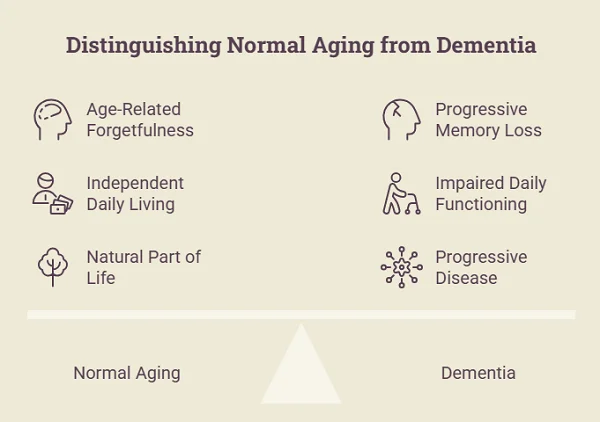
- If you forget a person’s name and then you recall it after an hour, it’s only age-related forgetfulness, it’s not a disease.
- Occasionally, losing keys, glasses, or your device is also normal aging memory loss.
- You may find that you take more time remembering details when engaging in a conversation.
However, the sign of healthy aging is that you don’t have a problem living on your own. Your own independent handling of money, preparing your own meals, and even driving would demonstrate normal healthy aging.
Although normal aging is considered harmless and non-disease-like, one could still get unsettled by it. As such, it’s a comfort to be in the know about what is medically concerning and what is not.
What is Dementia?
Dementia is the medical term for a group of conditions that cause progressive loss of memory, reasoning, and other cognitive functions that are bad enough to get in the way of daily life.
It isn’t something you’re supposed to get just because you’re older. It’s a disease process, and left untreated, it only gets worse. Our guide on dementia goes deeper into why age alone isn’t the cause.
NOTE: A few distinct conditions sit under the dementia umbrella. Alzheimer’s disease is the most common by far, making up roughly 60 to 70 per cent of cases worldwide, per the World Health Organization.
Vascular dementia follows strokes or reduced blood flow to the brain. Lewy body dementia brings hallucinations and movement issues into the mix, while frontotemporal dementia often changes personality before memory takes a hit.
Each type has its own dementia symptoms, though memory decline tends to connect them all. The dementia causes differ too; including genetics, vascular health, abnormal protein buildup, but they all lead to progressive cognitive decline if nothing’s done about it.
Knowing these categories is exactly why a real diagnosis beats guesswork every time.
Consult Dr. Abhishek Kumar – Book Your Appointment for Dementia Diagnosis
Dementia vs Normal Aging: Key Differences at a Glance
The clearest way to tell them apart? Frequency and impact. Someone dealing with normal aging memory loss forgets things now and then and still gets through the day just fine.
Dementia symptoms show up often enough to actually disrupt work, relationships, or safety. Think of this comparative table like a mental normal aging vs dementia chart:
| Factor | Normal Aging | Dementia |
| Memory | Occasionally forgets names or appointments but remembers them later. | Frequently forgets recent events or conversations. |
| Finding Items | Misplaces things occasionally and usually finds them later. | Places items in unusual places and cannot retrace steps. |
| Learning New Things | Learns new skills more slowly. | Struggles to learn or remember new information. |
| Language | Sometimes pauses to find the right word. | Often has trouble speaking or following conversations. |
| Daily Activities | Manages daily tasks without help. | Needs help with routine activities over time. |
| Problem Solving | Makes occasional mistakes but can correct them. | Has difficulty making decisions or solving simple problems. |
| Orientation | Knows the date, time, and familiar places. | May get confused about time, place, or familiar surroundings. |
| Mood and Behaviour | Personality stays largely the same. | May show noticeable changes in mood or behaviour. |
| Independence | Continues living independently. | Gradually becomes dependent on others. |
| Progression | Memory changes are mild and stable. | Symptoms gradually worsen over time. |
PEOPLE ALSO READ: Are Headaches a Sign of Dementia?
Think of the difference like forgetting an appointment but remembering it later is aging. Forgetting you even had one repeatedly is worth checking out.
That line between dementia vs aging, and between dementia vs normal memory loss, is exactly what a neurologist is evaluating during a cognitive assessment.
Also note that signs of dementia and ordinary memory loss in elderly people can look almost identical on the surface but play out completely differently over months.
>> Book a Consultation for Diagnosis from the Best Neurologists in Patna

Early Warning Signs That May Indicate Dementia
Some patterns go beyond typical slip-ups and deserve a doctor’s attention. The ability to detect them at an early stage gives you extra time to decide how you should proceed with the treatment plan.
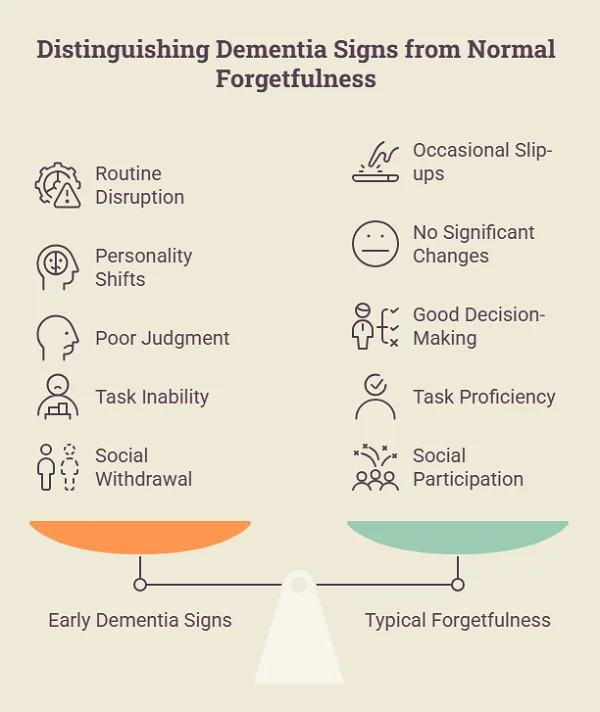
- The loss of memory that is so frequent in daily life that your routine is affected is definitely among the early dementia symptoms.
- Classic dementia warning signs include asking repetitive questions during one conversation; or forgetting when or where you are.
- Personality changes such as becoming unexpectedly suspicious, withdrawn or even irritable usually come along before memory problems.
- Getting confused and poor judgment about things such as giving large sums of money to others or being dressed incorrectly for the weather can also be significant indicators that one should not ignore.
- Becoming unable to perform tasks like cooking, paying bills and so on, which you used to be very good at, is an indication that something more serious than simple forgetfulness/memory problems is going on.
- losing the plot in a conversation or being unable to find the right words during a sentence.
- getting into the habit of ignoring to engage in social activities you used to love is, in fact, one of the earliest signs and is also one of the features most often overlooked by others.
Our full breakdown on early signs of dementia is worth a read for comprehensive details on identifying your initial symptoms.
None of these on their own confirms anything. But a pattern across several of them is reason enough to get checked.
When Should You Consult a Neurologist?
If these changes have been going on for a long time, you should contact a doctor rather than waiting it out.
Make an appointment with a neurologist to get a dementia memory loss diagnosis:
- If you keep forgetting more things, being stuck when doing daily work, or notice memory decline that’s quite sudden instead of slow.
- A few other behavioral changes plus a history of the disorder in the family may also push one to go early to see a neurologist for memory loss, rather than waiting it out.
In the first step, the brain specialist doctor does a physical neurological test together with a cognitive assessment in a structured form.
Further an MRI or CT scan will be needed to detect if there is a stroke or some accumulation of fluid, whereas if blood tests reveal such treatable diseases as thyroid malfunction, then those problems will be addressed.
In the vast majority of cases, it takes more than one test to decide on the diagnosis. In fact, it’s a whole set of exams and evaluations that leads to the diagnosis.
Dr. Abhishek Kumar is a Consultant Neurologist at Big Apollo Spectra Hospital, Patna, and has over 15 years of experience in diagnosing memory disorders and neurological diseases of patients.
>> Book Appointment with Dr. Abhishek Kumar if you’re noticing any of this in yourself or someone you love.
A timely evaluation from a qualified neurologist in Patna can be the difference between catching things early and missing the window to slow it down.
Can Dementia Be Treated?

There’s no cure for most types of dementia. But that doesn’t mean nothing can be done with the right care.
For example, for most dementia types, Alzheimer’s included, there’s still no permanent cure. That doesn’t make treatment pointless, though. Research keeps refining dementia treatment options, and symptoms can be managed well for years even without a cure.
Some medications, cholinesterase inhibitors and memantine, can stabilize memory and thinking for a while, especially in Alzheimer’s. They won’t reverse the damage, but plenty of patients and families notice real improvement in daily function while on them. These are standard Alzheimer’s treatment protocols used by neurologists everywhere.
Another thing to point out is that lifestyle changes do indeed make a significant difference in dementia management. In fact, regular exercise has repeatedly been associated with a delayed cognitive decline mainly through improved blood flow to the brain.
Eating a balanced diet, getting a good night’s rest, and keeping blood pressure and blood sugar level controlled all have a favorable effect on health in the long run.
IMPORTANT NOTE: Some of these habits, which have been neglected for a long time now, can actually be the driving force behind the disease. Our article on lifestyle habits that cause Alzheimer’s goes into more detail about this aspect.
Activities That Help:
Cognitive stimulation like doing puzzles, reading, learning new skills, and playing social games keeps the neural pathways active and has been shown to enhance mental sharpness in the early stages of dementia.
A short, daily 30-minute walk can uplift a person’s mood while also improving brain circulation. Such activities complement rather than replace the medication.
Most importantly, family support is equally crucial as a prescription. A caregiver who understands the condition and who keeps the patient’s routines consistent and is able to deal with confusion or agitation, helps the patient being calmer and feeling safe at home.
If mood swings make it the toughest part for you, check out our guide on dementia mood swings. It gives you a variety of strategies, practical tips, and day by day how-to-cope advice.
Diagnosis done early is the key that leads to longer periods of independent living, fewer crisis events and overall better quality of life. So it should not be surprising if those who get proper treatment first can prolong the period of independent living longer while meeting fewer crisis moments.

Frequently Asked Questions
1. How to tell the difference between dementia and aging?
Aging causes occasional, mild forgetfulness that doesn’t affect daily function, while dementia causes frequent memory loss that progressively disrupts routines and independence.
2. Is it normal to forget things at 75 years old?
Yes, mild forgetfulness like misplacing items or needing extra time to recall names is common at 75 and isn’t necessarily a sign of dementia.
3. Can people with dementia live a normal life?
With early diagnosis, medication, and lifestyle support, many people with dementia maintain a good quality of life and independence for years, especially in early stages.
4. Is it normal for a 90 year old to forget things?
Some forgetfulness is expected at 90, but frequent confusion, repeated questions, or getting lost in familiar places should still be evaluated by a doctor.
5. What are 5 warning signs of dementia?
Frequent memory loss, repeating questions, confusion about time or place, difficulty completing familiar tasks, and withdrawal from social activities are five common warning signs.
6. What causes 70% of dementia?
Alzheimer’s disease is responsible for roughly 60 to 70 percent of dementia cases globally, according to the World Health Organization.
7. What is the 3 word test for dementia?
It refers to a quick memory screening where a patient is asked to recall three unrelated words a few minutes after hearing them, used as part of broader cognitive assessments.
8. Is memory loss always a sign of dementia?
No, memory loss can result from stress, poor sleep, vitamin deficiencies, thyroid issues, or normal aging, not just dementia.
9. At what age does dementia usually begin?
Most cases appear after age 65, though early-onset dementia can occur in people in their 40s and 50s.
10. Can stress cause memory loss?
Yes, chronic stress can impair concentration and short-term memory, though this type of memory loss is typically reversible with stress management.
11. Can dementia be prevented?
There’s no guaranteed prevention, but regular exercise, a healthy diet, cognitive engagement, and managing blood pressure and diabetes can lower long-term risk.
12. What is the difference between Alzheimer’s disease and dementia?
Dementia is a broad term for cognitive decline, while Alzheimer’s disease is the most common specific type of dementia that causes it.
13. How is dementia diagnosed?
Diagnosis involves a neurological exam, cognitive testing, brain imaging like MRI or CT, and blood tests to rule out other treatable causes.
Don’t Ignore Persistent Memory Changes
Occasional forgetfulness is not dementia. The majority of memory slips are simply a part of aging which are harmless. The most important things to look at are the changes which persist over time, worsen and interfere with daily life. It needs more than worry, it requires the professional opinion, a medical check-up by the right doctor.
If you or a loved one are having problems with memory or changes in behaviours that are quite a big issue or concern, make sure to get a consultation with a senior neurologist.
At an advance neuro hospital Patna, Big Apollo Spectra Hospital, Dr. Abhishek Kumar and the entire neurology team are equipped to handle thorough diagnostic testing and formulate the right long-term care management plan for you.
To get peace of mind about your condition, consult Doctor/Book Appointment before things go out of hand.