Heart disease is the number-one cause of death in the world. According to the World Health Organization (WHO), cardiovascular diseases are responsible for an estimated 19.8 million deaths annually; or approximately 32% of all reported deaths globally.
Cardiovascular disease is growing rapidly in India as well. Studies have shown that Indians suffer from heart disease approximately ten years prior to their Western counterparts.
However, there is also significant fear associated with having a heart condition that will require surgery. Fortunately, there are many types of heart problems that do not necessitate surgery.
Most cardiac related problems can be managed with minimal intervention if diagnosed early. Cardiologists today emphasize early detection and treatment.
For this reason, BIG Apollo Spectra Hospital has numerous diagnostic testing options to help you assess your risk for cardiovascular disease at any stage — long before it develops into a medical emergency.
How Early Diagnosis in Cardiology Can Help You Avoid Heart Surgery & Complications?
Early detection helps eliminate risk factors associated with delayed care. Heart disease does not develop suddenly; rather, it develops over time, primarily through narrowing of your arteries, increasing blood pressure and/or gradually weakening your heart muscle.
The challenge is that people typically don’t go to the doctor until they experience severe symptoms. And by then, oftentimes the only treatment option is surgery.
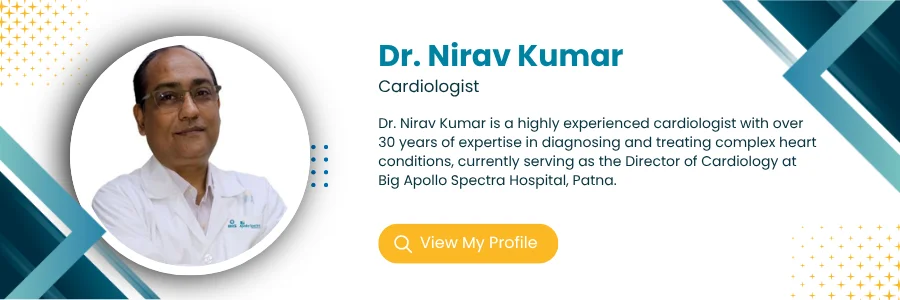
Early detection interrupts this process. This is why getting timely care is so crucial. Consult Dr. Nirav Kumar, the best cardiologist in Patna at the BIG Apollo Spectra Hospital for early detection and to remove any potential risks associated with late care.
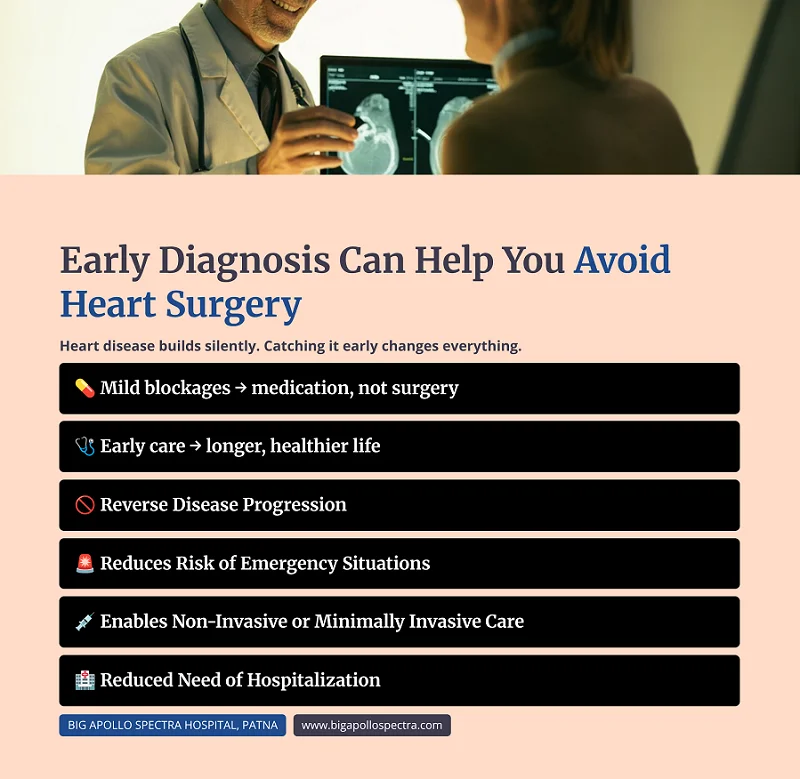
Here’s how early detection of cardiovascular disease impacts patient outcomes at every level:
1. Detects Disease Before It Becomes Severe
In the earliest stages of heart disease, the blockages/structural abnormalities that have developed are likely to be mild enough to be controlled using prescription medications. Statins are prescribed to help reduce cholesterol levels. Blood pressure is lowered with ACE inhibitors. Antiplatelets are prescribed to keep clots from forming.
A major study was published in the New England Journal of Medicine in 2020 titled “Health-Status Outcomes with Invasive or Conservative Care in Coronary Disease” (the ISCHEMIA trial).
In summary, the researchers concluded that an initial invasive strategy for stable coronary artery disease did not significantly reduce major cardiovascular events compared to optimal medical therapy. Therefore, those who have mild blockages will generally not need to undergo a bypass.
2. Slows or Reverses Disease Progression
The single largest finding in today’s preventive cardiology research is that many of the effects of cardiovascular disease are reversible if they are identified early enough.
For example, when patients who have been identified early for being at risk for developing atherosclerosis begin a series of changes including low sodium diet, regular aerobic exercise, and stop smoking along with their prescribed medication, they may experience regression of the atherosclerosis process and reduction of the degree of narrowing within the arteries.
Research from The Journal of the American College of Cardiology demonstrates that over time these same lifestyle intervention strategies may result in a decrease in the coronary plaque burden.
3. Reduces Risk of Emergency Situations
Without early diagnosis, the atherosclerosis could progress to such an extent that one of the affected arteries could rupture. At that point, the individual would not have the chance to be treated with medication when experiencing an acute myocardial infarction.
Generally, an acute myocardial infarction needs to be treated immediately with surgery like an emergency CABG or emergency angiography.
Besides avoiding surgery that may be necessary after the rupture, stopping the rupture with early detection also opens up the possibilities for non-invasive or minimally invasive treatments that could address different types of structural abnormalities in the heart.
Here you can see one of the biggest benefits of finding out about coronary heart disease early, allowing you to prevent severe outcomes.
4. Enables Non-Invasive or Minimally Invasive Care
The ability to get a minimally-invasive procedure for conditions that would otherwise require an “open heart surgery” operation has been possible because many of those same conditions can be treated via catheters using newer technologies. But that’s only possible if the issue is detected earlier in their development.
Because TAVR (Transcatheter Aortic Valve Replacement) and balloon valvuloplasty do not require a full incision into the chest wall they result in a much quicker healing time and fewer complications. Patients benefit from being diagnosed early enough so that they can avoid undergoing an open surgical procedure.
5. Improves Long-Term Heart Health Outcomes
Patients who receive an early diagnosis will generally enjoy superior long term results compared to individuals whose diagnoses were delayed; they will experience reduced rates of hospitalization, improved quality of life and extended survival.
The American Heart Association reports that the use of medications and/or lifestyle changes to control cardiovascular risk factors may reduce the incidence of major adverse cardiovascular events.
With ongoing monitoring of your heart health and the early heart disease detection you may live longer, healthier lives.
💡 Key Comparison: Early diagnosis = medication & monitoring | Late diagnosis = surgery & higher risk.
If you are concerned about your heart health, do not wait for symptoms to worsen. Dr. Nirav Kumar, Director of Cardiology at BIG Apollo Spectra Hospital, is one of the most trusted cardiologists in Patna.
With over 30 years of experience in the diagnostic evaluation of the cardiovascular system and interventional cardiology, Dr. Nirav Kumar leads a team that is equipped to identify risk at every stage — before it becomes a surgical emergency.
✅ Consult Dr. Nirav Kumar – Leading Cardiologist in Patna | Book Appointment at BIG Apollo Spectra Hospital
Who Needs Early Screening?
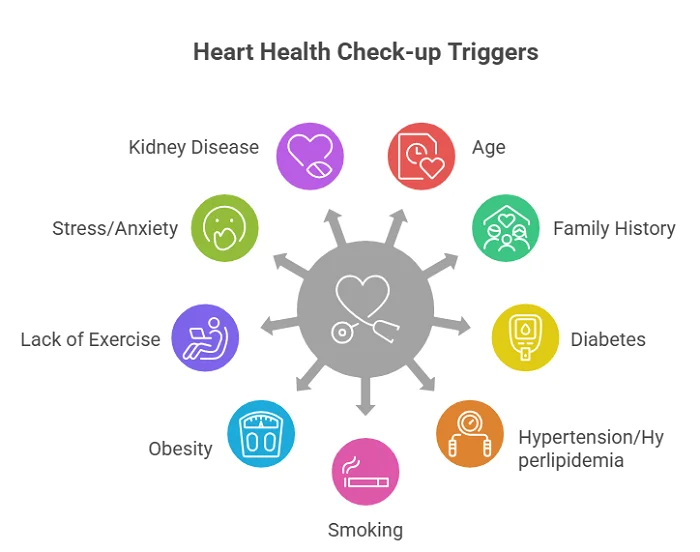
Risk based screening is when we identify individuals at higher risk for developing coronary artery disease as well as those that are already at a higher risk for having coronary artery disease before they show signs of symptoms, so that interventions can be done earlier.
PEOPLE ALSO READ: Understand What Causes Heart Disease in India?
The following groups may want to talk to their cardiologists about preventive cardiology screening for long-term heart health:
You might want to get your heart checked early if you:
- Are over the age of 40 years old (or over 30 years old with risk factors)
- Have a family member who was diagnosed with heart disease before the age of 55 (for men), or 65 (for women)
- Have a diagnosis of type II diabetes, or pre-diabetes
- Were diagnosed with either hypertension (high blood pressure), or hyperlipidemia (high cholesterol levels)
- Smoke or have used tobacco products heavily throughout your life
- Are obese/overweight and have an excessive amount of abdominal fat
- Do not engage in regular exercise on a daily basis
- Feel extreme amounts of stress/anxiety/sleeplessness frequently
- Are experiencing chronic kidney disease
Apart from these people, women who are post-menopausal should also think about a heart screening even if there are mild symptoms because oestrogen loss increases cardiovascular risk in these women.
Diagnosis and Tests in Cardiology
How does a cardiologist figure out whether a person has heart disease? Initially, a clinical evaluation is carried out, which consists of a person’s medical history, risk factors, physical examination. This is then followed by the identification of the suitable investigations.
The list of cardiac diagnostic tests for heart diseases range from a simple, non-invasive test that can be done in a matter of minutes, to sophisticated imaging studies that show the exact condition of the coronary arteries. Early heart disease detection is based on choosing the right tests at the right time.
1. Basic Tests
Initially, basic tests are done in any cardiac diagnosis. They do not require an invasive procedure with the patient and they are quite affordable.
Also, such tests could detect the existence of important abnormalities even in patients without any symptoms. If the results indicate a problem then more advanced tests are arranged. Such tests are the basis of any initial cardiac evaluation.
1. ECG (Electrocardiogram)
An ECG is the single most widely used heart test in clinical practice. It records the electrical activity of the heart and can detect arrhythmias, evidence of a previous heart attack, and signs of the enlargement of the ventricles. An ECG is done in less than 5 minutes and is in fact painless.
2. Blood Tests, Lipid Profile & Troponin
A fasting lipid profile checks total cholesterol, LDL, HDL, and triglycerides, all of them being independent risk factors for coronary artery disease. Troponin is a protein that is released into the blood upon damage to the heart muscle cells; an increased level of troponin serves as a current or recent heart attack indicator.
These tests combined provide a very illustrative indication of one’s cardiac risk and the extent of any injury.
2. Advanced Diagnostics
Advanced diagnostic methods come into play when initial testing indicates a potential problem, or a patient’s condition is very serious.
These tests enable the doctors to look at the heart’s inner structures and see its functions: the arteries, the valve operations and how well the heart is performing during physical activity.
1. Echocardiography
Echocardiogram or echo is a medical test which uses ultrasound waves to give a moving image of the heart. It essentially provides information on the size and shape of the heart chambers, the operation of the four heart valves, the strength of contraction or also called ‘ejection fraction,’ and any abnormal structures. It is a completely safe, non-invasive procedure without any use of radiation.
2. TMT (Treadmill Stress Test)
In order to check the effects of exercise on the heart, a stress test is carried out, which is also known as the TMT. The individual performs a walking exercise on a treadmill. During this time, an ECG and blood pressure are recorded without any interruption.
Coronary artery problems that are not visible when at rest can also be detected through changes in the ECG pattern reflecting during exercise. It is a very effective instrument for diagnosing coronary artery disease at its very earliest.
3. CT Angiography (CTCA)
CT coronary angiography involves the use of X-ray along with contrast dye for the generation of detailed three-dimensional pictures of the coronary arteries. It is capable of identifying even mild cases of atherosclerotic plaque before any symptoms show.
A coronary calcium score which is a simpler version of this test quantifies the amount of calcification in the arteries and quite accurately predicts the risk of a cardiac event in the future.
| Stage of Detection | Typical Finding | Likely Management |
| Early detection (no symptoms) | Mild blockage, elevated cholesterol, high BP | Lifestyle changes + medication |
| Intermediate (mild symptoms) | Moderate blockage, abnormal stress test | Medication + close monitoring |
| Late detection (significant symptoms) | Severe blockage, reduced heart function | Angioplasty (stenting) |
| Very late (emergency) | Complete blockage, acute heart attack | Emergency surgery (CABG) |
BIG Apollo Spectra Hospital, the leading heart hospital in Patna, is equipped with advanced cardiac imaging technology and an experienced cardiology team. All the tests listed above are available in-house, enabling rapid and accurate diagnosis from a single location.

Frequently Asked Questions (FAQs)
Following are some of the commonly asked questions asked by our patients about coronary artery disease and its detection.
1. Can heart disease be reversed if detected early?
The majority of the time, yes. If you are able to change your habits and take medication on time; then most of the time, you can slow down or even somewhat reverse coronary artery disease that is still at an early stage.
But you will not be able to completely reverse an advanced case of heart disease; however, you can stabilize it.
2. At what age should I start heart check-ups?
You could start at as young as 30, 35 if you are showing some risk factors such as diabetes, hypertension, a family history of heart disease, or obesity.
Conversely, if you show no risk factors, then you should begin screenings at 40 years old.
3. Are heart problems always symptomatic?
A substantial number of individuals diagnosed with significant coronary artery disease (CAD) have no symptoms prior to their first heart attack.
Therefore, in order to identify CAD in its earliest stages, regular screenings are essential for those who are considered high-risk.
4. Which test is best for early heart disease detection?
As there is no one best test; using multiple tests in conjunction with each other will provide the best results.
When beginning testing, obtaining an electrocardiogram (ECG), fasting lipid profile, and checking blood pressure will provide the best initial data. A stress test or CT angiography is typically recommended if the results from the initial tests indicate increased risk.
5. Can lifestyle changes alone prevent surgery?
YES. In many instances, patients experiencing early stages of heart disease can avoid a surgical procedure by implementing lifestyle changes and taking prescribed medication.
However, for moderate to advanced heart disease, in addition to lifestyle changes and/or medications; some form of minimally invasive intervention will likely be needed.
6. How often should high-risk patients get screened?
Patients who fall into the category of being “high-risk” which includes patients with diabetes, hypertension, a family history of heart disease, or those who have previously experienced a cardiac-related event, should obtain at least yearly screenings.
The frequency of screenings may vary based upon recommendations made by the cardiologist.
Take Action Before It Becomes an Emergency
Preventive cardiology is based on a very simple premise: the sooner heart disease can be diagnosed the greater the number of treatment choices will be available to you. In addition, the likelihood that you will need surgery will decrease as well.
Most individuals who have early stage heart disease are able to lead active, surgical free lives if they undergo appropriate diagnostic evaluations on time, make the necessary lifestyle changes, and receive timely medical intervention.
Big Apollo Spectra Hospital in Patna has a fully dedicated Cardiology department led by Professor Dr. Nirav Kumar, Director of Cardiology with over 30 years of experience.
All the various methods of detecting early stages of heart disease including ECGs and advanced CT Angiograms are available at the hospital under one roof. So, don’t wait until you have a chest pain emergency before taking your heart health seriously. Book your appointment with our heart specialist now!
➡️ Book a Cardiology Diagnostic Evaluation at BIG Apollo Spectra Hospital, Patna
Visit www.bigapollospectra.com or Call 0612-3540100