
According to the World Health Organization (WHO), dementia is one of the major health problems worldwide, currently affecting over 55 million people globally and every year the number of people diagnosed with dementia increases by 10 million.
Many family members only suspect that their loved one has developed dementia before the doctor gives the official diagnosis.
Maybe you observe that your family member repeats the same questions over and over again or don’t remember the things which had always been a part of their daily routine. They may also reveal new and unfamiliar aspects of themselves.
Being aware of the warning signs of dementia will enable you to quickly get your loved one diagnosed and start working on preserving their quality of life while also postponing the disease progression.
In today’s blog, you’ll find out about the common signs of dementia, the help-seeking process, and the treatment options if a family member has been diagnosed with a particular type of dementia.
What is Dementia?
Dementia simply means a group of symptoms caused by changes in the brain which are serious enough to interfere with daily life.
There are different types of dementia with varying symptoms but most people can recognize the main ones during the first few months or years after being diagnosed.
Although aging is a major risk factor, dementia is not something that happens inevitably to every elderly person so dementia is not synonymous with old age and it is not a normal part of aging.
Alzheimer’s disease is by far the leading type among dementia cases, coming in at roughly 60 to 70 percent as per WHO.
Other main types of dementia after Alzheimer’s remain vascular dementia, Lewy body dementia, and frontotemporal dementia. It is important that we recognize that both warning signs of dementia in elderly and dementia under 65 need equal attention.
11 Warning Signs of Dementia Explained

While memory loss is one of the most well-known indicators of dementia, many people don’t realize that there are other signs and symptoms as well.
Dementia can show itself in a person’s behaviour, in their speech, through changes in their physical abilities, in how they eat, and even in how they view reality.
Check out the following observation list for early signs of dementia and how they may appear in loved ones. Use this observation list as a tool to help family and caregivers know what to look for.
1. Difficulty Following TV Shows or Storylines
Warning signs of dementia are often masked. Before someone with dementia exhibits visible signs of memory loss or repeated misplacement of items, personality changes, delusions, strange behaviour, he or she may be having trouble following the plot line of a favourite TV program or repeating conversations and then asking for a repeat of the last few minutes.
As the disease progresses, the person with dementia may stop watching their usual shows altogether. This is one of the early signs of dementia in women and men that often goes unnoticed.
2. Increased Reliance on Simple Words or Generic Terms
Look for why you are making simple language mistakes. Look for how you rely on common language. When people first develop dementia, they often struggle with using the correct words.
At first, they substitute words with vague terms such as “that thing” or “the stuff.” They may label a kettle “the hot water machine”. This language difficulty is known as anomia, an early sign of dementia in men and women that can appear before other memory difficulties manifest.
3. Sudden Cravings for Sweet Foods
You may notice that the person with dementia has started to have a great liking for sugary foods such as chocolates, ice creams, cakes and pastries.
This change in eating habits is one of the early behavioural markers of dementia, especially in frontotemporal dementia, which affect a person’s behaviour and impulse control.
Such changes can be quite marked, for example someone who eats healthy foods starts to pester their family and friends for sweets all of the time.
A research published in the American Journal of Alzheimer’s Disease & Other Dementias® has noted changes in eating habits as an early behavioural marker.
4. Difficulty Understanding Depth, Distance, or Stairs
Visuospatial impairment – the inability to process visual information – affects people with dementia in many ways. They may have difficulty climbing stairs or judging the height of curbs, get knocked into objects in their way or have difficulty judging the distance to oncoming traffic. Thus, physical symptoms of dementia extend beyond memory.
It is important for families to be aware of such changes. You can seek an opinion from the best neurologist in Patna at Big Apollo Spectra, Dr. Abhishek Kumar (Consultant neurologist at BIG Apollo Spectra Hospital). With over 15 years of medical experience, he’ll help you find the cause of these changes with a proper evaluation.
5. Repeatedly Losing Track During Conversations
Not being able to complete a sentence, forgetting what you were going to say, frustration and avoiding social conversations.
These symptoms may occur in people with Alzheimer’s disease, dementia with Lewy bodies, frontotemporal dementia and vascular dementia, mainly if they are persistent or worsening. The underlying cause may be a problem with working memory and/or executive function.
6. Becoming Suspicious or Accusing Others Unnecessarily
Paranoia and mistrust are common characteristics in people with dementia. They may become upset and accuse a family member of taking something that has mysteriously disappeared.
They can also become suspicious of a caregiver or a loved one for no apparent reason. These paranoid delusions occur in about 31% of people with Alzheimer’s disease, according to a longitudinal study by Rubin.
7. Loss of Interest in Hobbies They Used to Love
The fading of a person’s motivation and passion for the things that once brought them joy is often among the warning signs of dementia at age 60 and even beyond.
Someone who used to do gardening, was a bookworm, or a party animal may suddenly give it all a miss. It is not just depression; brain changes affecting the motivation and reward systems may be the protagonist here.
8. Trouble Using Everyday Technology
The person suffering may forget how to send a text message, use the TV remote or a familiar app. These are all concerning signs of a failure to use technology.
Digital task initiatives require multiple sequential steps. When the brain becomes unable to deal with the step-by-step processes, familiar digital tasks become a source of confusion.
9. Regularly Leaving Things in Unusual Places
Everyone misplaces things from time to time. Yet a person who puts shoes in the kitchen, a wallet in the fridge, or glasses in the bathroom and cannot even remember how the item came to be there is a completely different story.
This is a classic warning sign of dementia in the elderly and indicates the declining ability to process spatial information.
10. Walking or Movement Changes
Slow steps, slower movement, unsteady balance, or feet being dragged can all be physical symptoms of dementia, especially Lewy body dementia and vascular dementia.
According to a 2017 review in The journals of gerontology. Series A, Biological sciences and medical sciences, gait changes often precede cognitive symptoms by several years. A neurological assessment is warranted if walking difficulties occur along with memory or behaviour changes.
11. Lowered Realisation That Something Is Amiss
There are some people who suffer from dementia who really don’t recognize that their memory or behaviour has changed – which is a condition called anosognosia, and affects over 80% of persons suffering from Alzheimer’s, according to the Cleveland Clinic.
These individuals may constantly say that their memory is fine, disregard the concerns made by relatives, and even get upset when the symptoms are indicated to them. This kind of reduced self-awareness is a neurological trait, not denial.
Note that many don’t have all these symptoms at the same time and having one or two of them alone is not automatically an indication of dementia. Nevertheless, if several of these changes happen at the same time or continue to get worse, a doctor’s consultation is needed.
➡️ Download the Dementia Warning Signs Leaflet
Causes of Dementia
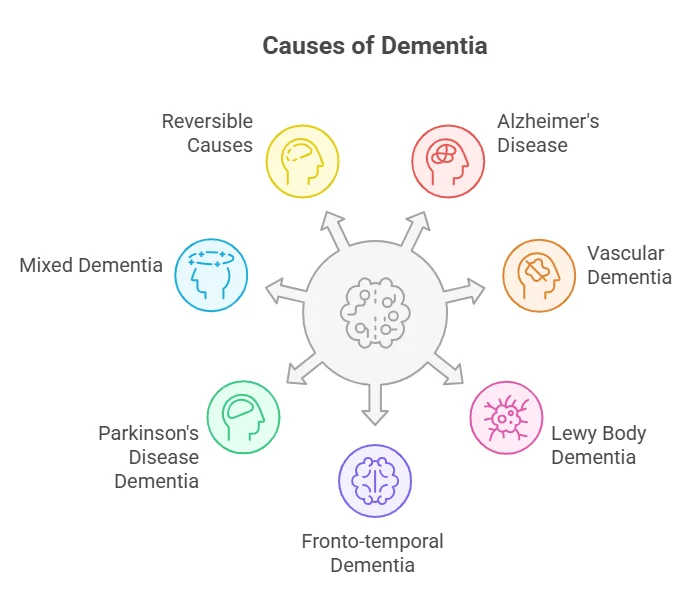
Dementia is caused by damage to brain cells that affects how they communicate. There are various reasons that lead to different forms of dementia.
- Alzheimer’s disease – The formation of amyloid plaque and tau tangle proteins can gradually destroy brain cells.
- Vascular Dementia – Blood flow to the brain has been compromised typically from one large stroke or multiple smaller strokes.
- Lewy body Dementia – Abnormal proteins referred to as Lewy bodies accumulate in the neurons of people who have this type of Dementia.
- Fronto-temporal Dementia – Progressive destruction of the frontal and temporal lobes results in significant behavioral and linguistic changes.
- Parkinson’s disease Dementia – Cognitive decline is a symptom that develops in the late stages of Parkinson’s disease.
- Mixed Dementia – There are many possible combinations of Dementia. The most common combination is Alzheimer’s disease and Vascular Dementia.
- Reversible causes – A Vitamin B12 deficiency, an issue with the thyroid gland, certain medications, or infection can result in changes that are treatable.
Why knowing the cause matters:
Knowing the cause of a person’s dementia helps doctors determine the appropriate course of action for treatment. This also allows doctors to help patients identify the most effective form of long-term care based on the diagnosis.
Thus, understanding the reason why a patient is developing dementia is extremely beneficial when deciding whether now may be the right time to schedule a visit with a doctor.
When Should You See a Doctor?

It’s quite normal to forget someone’s name once in a while or to lose your keys a bit more often as you get older.
However, if you keep experiencing such forgetfulness regularly, even to the point of affecting your life, and you see no signs of improvement, then these are the moments when you shouldn’t overlook such issues.
Since symptoms for dementia can be similar to the ones for depression, anxiety, vitamin B12 deficiency, thyroid problems, or side effects of some medications, a professional assessment is very necessary instead of just assuming the worst.
You should definitely see a doctor if you or someone else you are looking after exhibits any of these:
- Repeatedly asking the same question within minutes
- Getting lost in places you are very familiar with
- Changes in mood and personality that cannot be easily explained
- Having difficulties with handling finances, medication, or other daily activities
- Being unaware of or having difficulty managing day, date, season, or time of the year
- Having trouble understanding or speaking the language
- Staying aloof of family, friends, or withdrawing from activities
- Suspicion, aggression, or hallucinations increasing
At Big Apollo Spectra, a head specialist doctor in Patna can conduct the initial evaluation and find out if the problems are caused by treatable diseases or conditions.
Being assessed early doesn’t mean an immediate diagnosis of dementia. In fact, quite a few causes of cognitive decline are reversible. The earlier you take the step of asking for help, the better will be the outcome.

Diagnosis & Tests
Several steps must be followed when diagnosing for dementia. First, a doctor will collect a comprehensive medical history of the patient, check the list of current medications, and test the patient’s cognition with either the Mini-Mental State Examination (MMSE) or the Montreal Cognitive Assessment (MoCA).
To exclude possible reversible conditions, the blood is tested for thyroid problems or vitamin deficiencies. CT scans and MRI are brain imaging techniques that reveal structural changes or stroke signs.
Sometimes, a PET scan or cerebrospinal fluid analysis is also done. A neuropsychological assessment is useful for assessing various cognitive functions in detail. Also, there is no one test that can verify dementia; the diagnosis is made based on a thorough assessment.
What are the Treatment Options for Dementia?
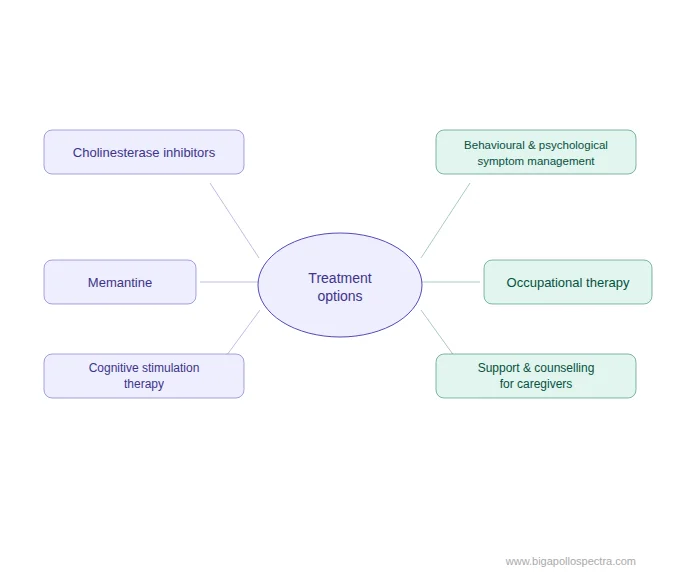
As of today, most forms of dementia do not have cures but they can be treated with various therapies that reduce their symptoms, slow down their progression, or improve the person’s overall quality of life.
A neurologist will recommend various treatments based on the type and stage of the disease, such as medications, therapy, and/or changes in a person’s daily routine.
Medications for Treating Dementia
There are three common types of prescription medications that treat dementia:
- Cholinesterase Inhibitors – These medications consist of Donepezil, Rivastigmine, Galantamine. These are the most commonly prescribed medications for treating the symptoms of Alzheimer’s Disease. By increasing the availability of acetylcholine in the brain, these medications help protect and preserve cognitive abilities.
- Memantine – It is a treatment option for moderate to severe Alzheimer’s disease and that works by controlling glutamate activity. At times, this drug is used in conjunction with cholinesterase inhibitors to enhance the effects.
➜ Consult Dr. Abhishek Kumar (Neurology) at BIG Apollo Spectra Hospital , Patna.
Cognitive Stimulation Therapy (CST)
CST has been shown to be an effective treatment method where individuals with dementia engage in a variety of structured, planned activities. These activities are designed to stimulate mental functions like memory and thinking abilities.
Note that while CST was developed as a group activity it may also be implemented as individualized activity plans. The primary purpose of CST is to encourage individuals with dementia to remain active and involved in maintaining social functioning.
The National Institute for Health and Care Excellence (NICE) considers CST a form of effective treatment for those experiencing mild to moderate symptoms related to dementia.
Behaviour Management and Treatment of Behavioural & Psychologic Symptoms
In many cases, behavioural problems associated with dementia (such as agitation, anxiety, paranoid behaviours) may initially be managed without the use of medication (for example, developing a consistent schedule of daily routines for the patient, creating a less stressful environment for them), and if medication is required then it should be prescribed by a neurologist who understands what would be best suited for each patient.
Occupational Therapy
Through changing a person’s home environment and routines, an occupational therapist can help someone stay self-sufficient for the longest time possible.
Support and Counselling for Caregivers
Dementia affects all family members. Providing education for caregivers, encouraging them to join support groups, and giving them counseling are fundamental components that ensure both the patient and their family members receive adequate support.
There is one more reason to pay attention to the earliest signs and make a quick decision to seek medical help: the earlier the treatment is started, the more effective the results can be.

How to Prevent Dementia?
Though in certain instances dementia may be inevitable, the research clearly indicates that when it comes to brain health, lifestyle choices play an important role.
According to a recent update from The Lancet in 2024 about 45% of dementia cases can be delayed or prevented through intervention in modifiable risk factors.
- Stay physically active – Engaging in 150 minutes of moderate aerobic activity each week keeps brain blood flow optimal and helps reduce vascular risk.
- Eat a brain-healthy diet – Both Mediterranean and MIND diets are linked to less cognitive deterioration as per research.
- Control blood pressure and diabetes – These are the two main risk factors for vascular dementia.
- Give up smoking and limit alcohol intake – Smoking increases the risk of dementia by two times while alcohol consumption at an excessive level is a separate risk factor.
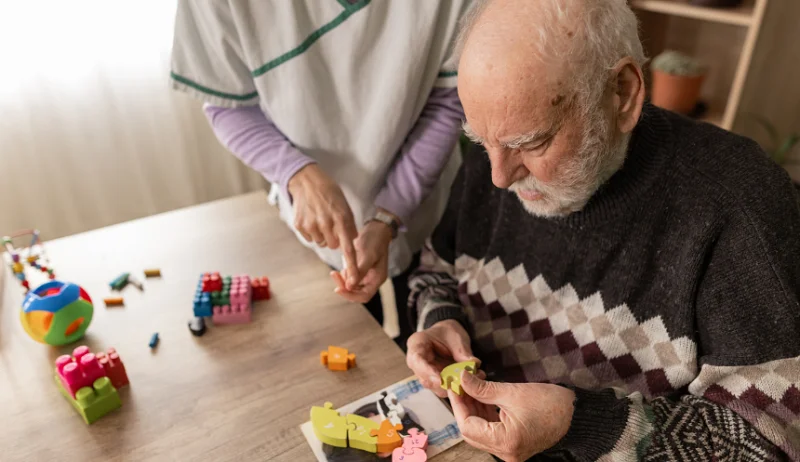
- Keep yourself mentally stimulated – Reading books, gaining knowledge with new skills, playing chess or doing puzzles serve as mental workouts.
- Have regular social interactions – A study conducted in 2022 at the University of Cambridge revealed that loneliness and social isolation lead to a higher risk of dementia.
- Get enough sleep – The brain removes amyloid proteins when you sleep. Years of poor sleep quality can increase risk.
- Address hearing loss promptly – The Lancet Dementia Commission states that hearing loss is one of the largest modifiable risk factors and can cause harm if left untreated.
Prevention is not about removing every single risk factor but rather about always making choices that support brain health.
Frequently Asked Questions (FAQs)
Please find below a list of some questions that have been frequently raised by our patients. These questions are designed to help you gain a better understanding of the condition:
1. How does your body warn you that dementia is coming?
Initially, as far as physical as well as cognitive changes go, you may experience memory failures, trouble in carrying out tasks that once were familiar to you, language difficulties, mood swings, poor balance, and altered eating habits.
2. What is the final stage of dementia?
A person in the final stage normally loses the ability to communicate, needs full-time help with every activity of their day, and is very prone to getting infections and other physical problems.
3. Can dementia be treated?
There is no cure for dementia, however, medications and therapies help in slowing down the disease as well as improving symptoms to enable better daily functioning and increase the quality of life.
4. What is the difference between Alzheimer’s and dementia?
Dementia refers to a wide range of symptoms while Alzheimer’s disease is a specific type of dementia, and the one that is most common, making up 60, 70% of cases.
5. What are the signs dementia is getting worse?
The advancement of dementia can be evident by increased confusion, more difficulty in performing self-care, more falls, loss of speech, failure to recognize close family members, and problems with swallowing.
6. What not to do when someone has dementia?
Never argue or keep on correcting them, hurry them, talk about them in the third person as if they are not there, or leave them alone in risky situations.
Download the Free Dementia Warning Signs Guide and Help Someone Today.
Don’t Ignore Early Dementia Warning Signs
Recognizing the dementia warning signs early on, whether you are keeping an eye on warning signs of dementia in the elderly, looking for warning signs of dementia in people under 65 years old, or identifying early signs of dementia in women or men, can make a real difference in outcomes.
The sooner a diagnosis is done, the more options there are for management of dementia. Do not wait for symptoms to get very bad before seeking a consultation.
Big Apollo Spectra Hospital can assist if you or your loved one has started to show any signs talked about in this piece. As a reputed advanced neuro hospital in Patna, Big Apollo Spectra has expert neurologists, modern diagnostic equipment, and complete dementia care all under one roof.
Book an appointment today by calling 0612-3540100 or visiting www.bigapollospectra.com.